

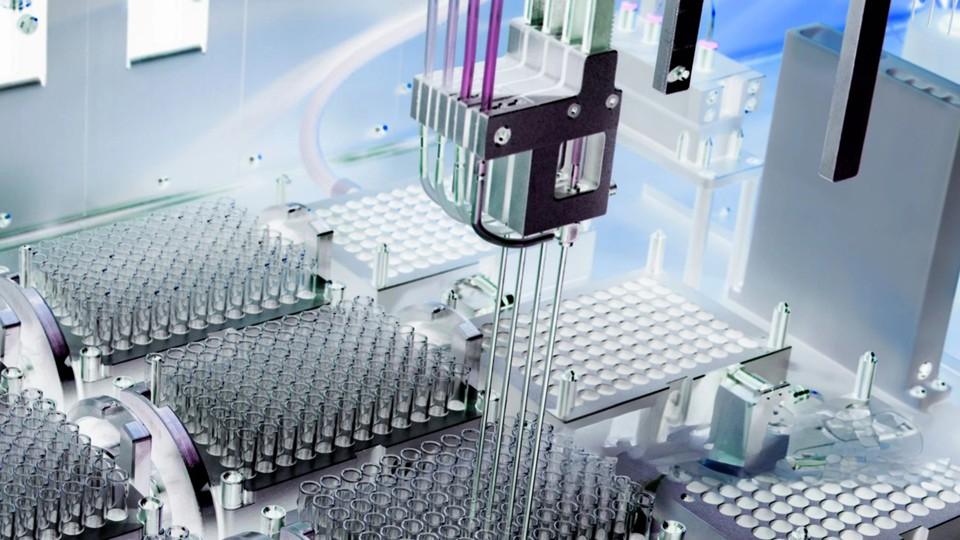
Somewhere between a promising compound and a Phase I study sits a bottleneck most people outside the industry never think about: sample analysis. Thousands of biological samples, each requiring precise measurement of drug concentrations, metabolite profiles, and immunogenicity markers, all flowing through labs that, until recently, depended heavily on manual pipetting, manual logging, and human review at every step. The speed of that process used to be the speed of the people doing it. That’s changed.
Automation has quietly redrawn what’s possible in bioanalytical science, and the ripple effects reach all the way to drug approval timelines.
Why the Pressure on Bioanalytical Turnaround Has Never Been Higher
The sheer volume of drug research today makes the old manual model unsustainable. As of August 2024, ClinicalTrials.gov, the registry run by the U.S. National Library of Medicine, listed more than 500,000 studies across all 50 states and 222 countries. Every one of those studies generates biological samples that need to be analyzed, validated, and reported. The aggregate demand for bioanalytical capacity is enormous, and sponsors aren’t willing to wait months for data that used to take weeks.
Sponsors are also spending more than ever. A 2024 analysis reporting on a Nature Reviews Drug Discovery study found that global R&D investment of $276 billion in 2021 was nearly triple the amount the industry spent on sales and marketing , putting into sharp relief how much rides on making that R&D budget efficient. Slow sample turnaround burns through budget without generating decisions. That math is why sponsors are moving toward automated bioanalytical partners as a core program requirement, not an afterthought.
What “Automation” Actually Means Inside a Bioanalytical Lab
The word gets thrown around loosely, so it’s worth being specific. Bioanalytical automation is not a single technology. It’s a stack of integrated systems working across the sample lifecycle.
At the front end, automated liquid handling robots replace manual pipetting for sample preparation. A single robot can process a 96-well plate in a fraction of the time a skilled analyst takes, and it does it with a coefficient of variation that manual technique simply can’t match at volume. That consistency matters enormously because variability in sample prep propagates through every downstream measurement.
In the middle of the workflow, integrated LC-MS/MS platforms now accept samples directly from prep robots, run analytical sequences autonomously, and flag anomalies in real time rather than waiting for a human reviewer to catch them during batch review. Some platforms close the loop entirely: a flagged sample triggers automatic reinjection before the analyst has even looked at the queue.
At the back end, laboratory information management systems (LIMS) replace manual data transcription with direct instrument-to-database connections. The audit trail is built automatically. Regulatory submissions pull from a single source of truth. Version conflicts, the nightmare of legacy spreadsheet-based labs, become structurally impossible.
The Sample Volume Triage Framework
Here’s something not every sponsor thinks through before selecting a bioanalytical partner: automation doesn’t help you equally across all sample types. The efficiency gains are sharpest in high-volume, low-complexity runs and smallest in early-stage exploratory assays where methods are still being developed. A useful internal framework for evaluating whether automation will actually compress your timeline is what you could call Sample Volume Triage, a three-question test applied to each study type:
- Volume question: Are you running more than 500 samples per analytical batch? If yes, automated liquid handling will meaningfully reduce prep time. If no, manual prep with strong SOPs may be just as fast once setup time is factored in.
- Stability question: Has the method been fully validated, or is this a development phase where protocol changes are expected? Automation investment is recouped over repeatable runs. Early exploratory work may not justify the switchover cost.
- Regulatory question: Does this data need to meet GLP or GCP standards for submission? Automated audit trails are not just convenient here, they’re practically essential. Manual logs become a compliance liability at scale.
Running this triage before a study kicks off prevents the common mistake of assuming that more automation is always better. Sometimes you want a highly flexible manual setup. Mostly, though, sponsors with mid-to-late phase programs come out ahead by moving automated as early as possible in their Bioanalytical Method Development and Validation strategy.
Speed Without Sacrificing Regulatory Compliance
The tension that used to exist between speed and compliance in bioanalytical work has largely dissolved for labs that have invested in automation correctly. The concern was always that faster throughput meant less time for human verification, and less human verification meant more risk of regulatory findings. Automated systems actually invert that logic. They run the same checks every single time. They don’t skip a verification step because it’s 11 p.m. and the batch needs to close.
This is especially important for labs operating under both FDA and EMA guidelines simultaneously, which is standard practice for any sponsor running multi-regional programs. Regulatory harmonization across those two frameworks requires meticulous documentation of method validation, system suitability, and incurred sample reanalysis. Manual labs handle this with armies of QA staff and thick paper trails. Automated labs build it into the workflow architecture from day one.
Sponsors evaluating bioanalytical partners should look specifically at how automation integrates with the lab’s quality management system, not just whether automation exists at all. A lab with robots that feed data into a disconnected spreadsheet has not actually solved the compliance problem. The integration matters as much as the hardware.
Practical Checklist: Evaluating a Bioanalytical Lab’s Automation Maturity
Before committing a study to a particular lab, run through these five checkpoints:
- Sample prep robotics: Ask specifically about liquid handling systems and whether they’re validated to the same standard as the analytical instruments.
- LIMS integration: Confirm that instrument data flows directly into the LIMS without manual transcription at any stage.
- Batch capacity per day: A high automation lab should be able to run multiple large batches concurrently; ask for real throughput numbers, not theoretical maximums.
- Real-time anomaly detection: Find out whether the system flags and reacts to out-of-specification results automatically or whether that step still requires a human in the loop.
- Audit trail depth: Request a sample audit trail from a completed study and check that it meets the depth required by your regulatory authority without additional manual annotation.
Partners like Celerion.com have publicly documented capacity for over 600,000 samples per year with automated facilities in both the U.S. and Europe, which is the kind of concrete throughput benchmark worth asking other labs to match before signing a contract.
Where This Is All Heading
The next wave isn’t just faster automation. It’s smarter automation, with machine learning models trained on historical batch data predicting which samples are likely to fail QC before the run even completes. A few leading labs are already piloting predictive maintenance systems that flag instrument drift before it corrupts a batch. The value proposition there isn’t just efficiency, it’s data integrity, which is the single most irreplaceable asset in a clinical program.
For drug developers, the decision about which bioanalytical partner to use is increasingly a decision about data infrastructure. The lab that can process your samples fastest while maintaining the tightest compliance documentation is effectively shortening your critical path to the clinic. That’s worth spending real time on during vendor selection, not just checking a box because a lab passed its last audit.
Speed and rigor used to feel like a trade-off. The best automated bioanalytical labs have made that a false choice. The question now is which sponsors are moving fast enough to take advantage of it.
| Lab Automation Component | Primary Benefit | Regulatory Impact
|
|---|---|---|
| Automated liquid handling | Reduces prep variability; faster 96-well throughput | Lower CV improves method validation reproducibility |
| Integrated LC-MS/MS with auto-reinjection | Catches anomalies in real time; reduces reruns | Supports continuous system suitability monitoring |
| LIMS with direct instrument feeds | Eliminates manual transcription errors | Automated, unbroken audit trail for FDA and EMA |
| Predictive QC flagging (ML-assisted) | Identifies failing samples before batch completes | Reduces OOS investigations and deviation reports |
“The integration of automation and digital tools into bioanalytical workflows is not simply an efficiency play. It is becoming the baseline expectation for sponsors running multi-regional programs under dual regulatory oversight.” — Emerging consensus among early-phase clinical research practitioners, reflected across FDA guidance updates and EMA bioanalytical method validation guidelines published in recent years.
