

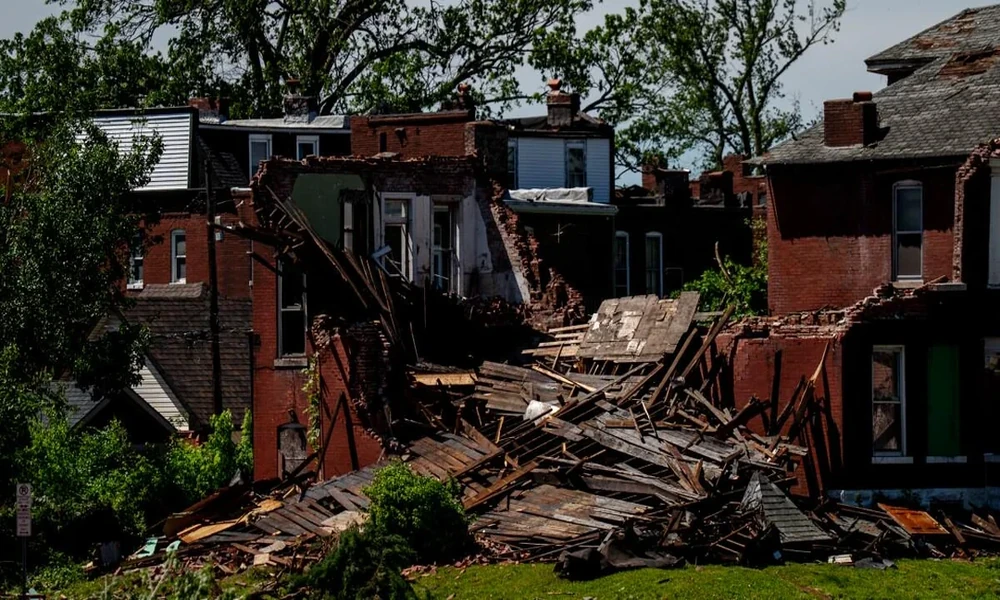
Most St. Louis landlords don’t lose a renter because the roof leaked. Around 96 percent of tenants whose damage gets handled in the first three days renew their lease anyway. They lose the renter because the building sat open for four days and the tenant spent those nights at their sister’s house in Affton, quietly deciding they’re never signing another lease here. I’ve watched both versions happen on the same block after the same storm, and the difference is never luck. It’s a script.
I’ll give you the script below, including the exact order I’d handle things if a Tuesday night hailstorm peeled the siding off my own duplex. It saves renters, and it does one more thing nobody warns you about. It saves you from the repair bill that shows up three months later.
The real turnover math nobody runs before they panic
Here’s what an empty unit actually costs you in St. Louis. Say the place rents for $1,300 a month. A re-rent cycle means a vacant month, a turn, a listing, and a screening, and by the time someone hands over a deposit you’re somewhere between $2,500 and $3,500 lighter. Compare that to what it costs to keep the current tenant calm and housed: a hotel for a few nights, a storage unit, and a couple of honest phone calls. The gap between those two numbers is the whole game.
So when the siding is flapping and the tenant is texting you at 11 p.m., the loud instinct is to worry about the repair estimate. The correct instinct is to protect the relationship first, because the tenant is the asset with the longest runway. You can repair a soffit in a week. You can’t repair a renter who has already told their coworker about the leak.
Emergency response is a loyalty product, not a maintenance cost. Price it that way and every other decision gets easier.
What the first 72 hours actually decide
Insurance paperwork hasn’t even started in that window, and yet it sets the outcome. What a resident remembers is whether you called back, whether someone with actual authority showed up, and whether the building looked worse on day two than it did on day one. Tarp something. Board the broken window. Do anything visible, because visible action is what tells a tenant their home still has an owner.
The weather itself doesn’t help. The National Weather Service records how often the St. Louis region swings between flash flooding, hail, and straight-line wind in a single season, and none of it asks your permission first. When the National Weather Service sends one of those alerts, your renter sends three texts. Which one of you sounds calmer in the morning decides whether they renew.
I’d run the first day in this order, and I’d run it even for a tenant who says they’re fine, because “I’m fine” is what polite people say right up until they move out:
- Call or text within an hour with two sentences maximum. What you know. What happens next.
- Get the structure closed before dark. If glass or framing is damaged, a board up company in St. Louis, MO, gets referred here in this exact conversation, so the word “board up” never has to be explained to a frightened person.
- Photograph everything before any repair begins, from four angles, with something for scale. Timestamped photos are the backbone of a claim and the reason a tenant stops worrying about being blamed.
- Say the sentence out loud: repairs won’t come out of your deposit. Renters carry a quiet fear that damage is a debt, and that fear is the actual cause of the midnight move-out.
The order matters. Closing the structure before you’ve made contact means the tenant watches strangers work on their home before they hear from their landlord. That puts the sequence backwards and it’s hard to unring.
Choosing who secures the building when it’s 2 a.m.
I’d pick a locally owned outfit that dispatches a real crew over the phone, not a national call center that subcontracts another subcontractor. In an ice storm, a chain of middlemen adds hours you don’t have, and your tenant sees the delay. Based on the local operations I’ve dealt with, the ones who answer their own line at night and can walk a claim through an insurer’s paperwork are the only ones worth the rate, because the money you think you saved on labor shows up again as a two week vacancy.
Three questions when you call. Ask whether they handle the claim documentation themselves. Ask for a realistic arrival window and hold them to it. And ask who’s actually on the truck, because “we’ll send somebody” is how you end up with a different company’s sign in your tenant’s yard.
The repair that eats next year’s cash flow
Weather exposure doesn’t just annoy your renter. Water that gets in through a taped window frames warps, and by May you’re replacing drywall in a unit you thought you’d handled in January. The Small Business Administration publishes guidance on surviving a disruptive events as a tenant-friendly operator, and the plainest lesson in it applies here: unaddressed exposure compounds. It never stays the same size.
For a landlord, compounding exposure means a two week repair stretches over two turnovers. That’s the real reason I push hard on the board up step. It’s cheap against the upside, and it keeps the work in one season instead of three.
The script I’d hand a property manager tomorrow
Written down, this is what the first shift looks like. Nobody has to invent it a 2 a.m.:
- Minute 5. Open the emergency logged log and note the time of the first report. That timestamp goes in your insurance file.
- Minute 30. One message to the affected tenant with the plan and a callback window. Keep it short and specific.
- Hour 2. Confirm who’s coming, whether they’ll board, tarp, or both, and whether they send documentation for your claim.
- Hour 6. If the tenant can’t stay, arrange a hotel and put it in writing. A written agreement is how you hold a worried resident’s trust.
- Day 2 to 3. Set the repair timeline and send it to the tenant, prefer text or email so it’s in their hands.
- Day 7. Follow up. The storm is over for everybody but the person living without a window.
Notice what’s missing: no discussion of blame, no guesswork about cost, no waiting for the estimate before you communicate. Every one of those silences gets filled by the tenant with their own worst assumption.
During the storm, the little stuff earns the renewal
Landlords who put themselves in a renter’s chair for ten minutes keep tenants for years. You’re not just fixing a building. You’re being asked to prove you’ll show up when it’s inconvenient, and there aren’t many chances to prove that. A tenant will forgives a broken window. They won’t forgive a building left open with their clothes still in it.
So the real test isn’t the storm at all. It’s the calmer conversation afterward, when a renter sees a dry, closed, photographed unit and decides that this address is still home. Handle the first 72 hours right and you’ll have both a damaged roof and a signed renewal. Which one do you want to be handling first?
